
Rifle chassis systems. A chassis replaces a traditional stock with a machined aluminium spine that the barrelled action bolts directly into. The point is repeatability: metal does not move with humidity, does not compress under a bipod, and returns the action to exactly the same place every time it is torqued down.
That matters most on a suppressed rifle, because you are already asking the barrel to deal with a pound or more hanging off the muzzle. A chassis is the part of the rifle that stops flexing under it.
See also complete firearms, firearm parts and handguards.

Chassis
Chassis

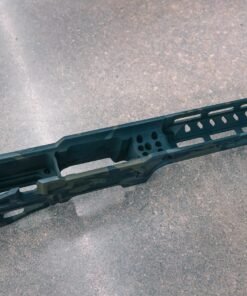
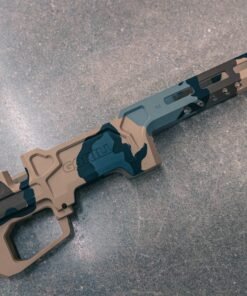


Chassis, or a traditional stock?
The honest position is that a good bedded stock and a good chassis both shoot well. What a chassis buys you is adjustability and consistency without gunsmithing.
| Chassis | Traditional stock | |
|---|---|---|
| Action fit | bolts to machined aluminium, no bedding needed | usually needs bedding to match |
| Adjustability | length of pull and comb, tool free on most | fixed, or shims and spacers |
| Weight | heavier, which steadies the rifle | lighter, better for carrying |
| Magazines | detachable box, usually AICS pattern | often internal, depends on the rifle |
| Accessory mounting | M-LOK throughout | limited, needs adapters |
| Stability in weather | unaffected by humidity | wood moves, composite less so |
The trade is weight. A chassis rifle is heavier than the same action in a hunting stock, and on a rifle you carry all day that is a real cost. On a rifle shot from a bipod, the weight is a benefit rather than a penalty.
Why a chassis suits a suppressed rifle
Fitting a suppressor adds one to two pounds at the very end of the barrel, which is the worst possible place for weight from a stability point of view. It changes barrel harmonics, it loads the fore end differently on a bipod, and it makes any flex in the system show up on target.
A rigid aluminium chassis with a free floating fore end does two useful things about that. It does not deflect under the added muzzle weight, so your point of impact shift stays consistent rather than varying with how hard you load the bipod. And it keeps everything you bolt on, bipod, bags, weights, attached to the chassis rather than to anything touching the barrel.
Point of impact will still shift when you fit the can. That is unavoidable. What a chassis helps with is making the shift repeat, which is the part that actually matters. Our 6.5 Creedmoor suppressor page covers why repeatability beats raw sound reduction on a precision rifle.
What to check before buying
Action inlet. A chassis is machined for a specific action footprint, most commonly Remington 700 pattern, which many other actions copy. Confirm your exact action and whether it is short or long action before ordering. This is the one thing you cannot adapt around.
Magazine pattern. Most chassis use AICS pattern detachable magazines, which are widely available. Check the length: a short action magazine will not accommodate long cartridges seated out, and this catches people using heavy high BC bullets.
Fore end length and attachment. A longer fore end gives more room for a bipod forward and a barricade stop, and adds weight. M-LOK is effectively the standard for attaching things and worth insisting on.
Barrel clearance. Heavy contour barrels need a fore end machined to clear them. Check the maximum barrel contour the chassis accepts, particularly if you are running a heavy profile with a suppressor.
Adjustability. Length of pull and comb height are what let you build a consistent position behind the rifle. Comb height matters more once a suppressor is fitted, because people often change optic height at the same time.
Setting one up
Torque the action screws to the manufacturer's specification with a torque wrench, not by feel. This is the single most common setup error, and both under and over torquing will cost you accuracy and consistency.
Set length of pull so your trigger hand sits naturally without stretching or crowding, then set comb height so your eye lines up with the optic when your cheek rests naturally rather than when you consciously position it. If you are adjusting your head to find the reticle, the comb is wrong.
Then re zero. Moving a rifle into a chassis changes how the action sits and will move your point of impact, so treat it as a new rifle until you have confirmed on paper.
Which cartridges this suits
Chassis rifles are most common in precision cartridges: 6.5 Creedmoor, .308 Win, .260 Rem and the magnums. Those are the rifles shot from bipods at distance, where rigidity and adjustability pay for the weight.
They also suit heavy subsonic rifles more than people expect. An 8.6 Blackout bolt gun with a large .338 can hanging off a short barrel benefits from a rigid platform, and the weight is less of a penalty on a rifle that is shot at woods ranges rather than carried for miles.
Frequently asked questions about rifle chassis
Will a chassis make my rifle more accurate?
It makes it more consistent, which usually shows up as better groups over time. A rigid, repeatable platform removes variables rather than adding accuracy the barrel does not already have.
Do I need to bed a chassis?
No. The action bolts directly to machined aluminium, which is the point. Torque the action screws to specification and it is done.
Will my action fit?
Check the inlet. Remington 700 pattern is the most common footprint and many actions copy it, but confirm your exact model and whether it is short or long action before ordering.
What magazines does a chassis use?
Usually AICS pattern detachable box magazines. Check the internal length if you seat long high BC bullets, since a short action magazine can limit your overall cartridge length.
Is a chassis too heavy for hunting?
For rifles you carry long distances, often yes. For a truck rifle, a stand rifle or anything shot from a bipod, the weight steadies the rifle and is a benefit.
Does a chassis help with a suppressor?
Yes, indirectly. It does not stop point of impact shifting when you fit the can, but a rigid free floated platform makes the shift consistent, which is what lets you record it as a known offset.
How tight should the action screws be?
To the manufacturer's specification, measured with a torque wrench. Guessing is the most common setup mistake, and both too loose and too tight cost accuracy.
Do I need to re zero after fitting one?
Yes. Moving the action changes how it sits and will shift your point of impact. Confirm on paper before you rely on it.