Rifle barrels. The barrel decides more about how a rifle shoots than any other component, and it carries the two specifications that cannot be corrected once cut: the chamber and the twist rate. Everything else on a build can be swapped.
The guide below covers twist, length, gas system length and thread pitch, in the order you should decide them, with the emphasis on suppressed builds where the choices interact.
See also 8.6 Blackout barrels, uppers, firearm parts and handguards.
8.6 Blackout Ammo
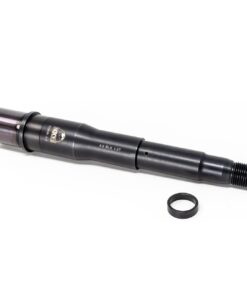
Faxon Duty Series 8 Inch 8.6 Blackout Pistol Length AR-10 Barrel
Twist rate first, because it is permanent
Twist rate is how far the bullet travels to make one full rotation, and it determines which bullets your barrel can stabilise. Too slow for the bullet and you get keyholing, oval holes in paper and groups that make no sense.
| Cartridge | Twist | Stabilises |
|---|---|---|
| 8.6 Blackout | 1:3 | up to 342gr .338 subsonic |
| 338 ARC | 1:5 | up to roughly 307gr .338 subsonic |
| 300 Blackout | 1:7 or 1:8 | up to 220gr .308 subsonic |
| 5.56 and .223 | 1:7 to 1:9 | 1:7 for 77gr, 1:9 up to about 62gr |
| 6mm ARC, 6.5 Grendel | 1:7.5 or 1:8 | the full common weight range |
| .308 Win, .30-06 | 1:10 or 1:12 | the full common weight range |
The subsonic cartridges are where this matters most. Heavy slow bullets need aggressive spin both to stabilise and, in the Blackout cartridges, to drive the expansion of projectiles that have very little impact velocity to work with. A slower twist barrel will fire the ammunition and remove the reason you bought the cartridge.
Length, and when it actually buys you something
Different cartridges reward length very differently, and assuming longer is better costs handling for nothing on some of them.
Subsonic cartridges barely care. 8.6 Blackout and 300 Blackout finish burning their powder in roughly 8 inches, and subsonic velocity is capped under the sound barrier by design. Across eight extra inches you gain about 30 fps, so 12 to 16 inches captures everything.
Velocity cartridges do care. 6.5 Creedmoor, .308, .30-06 and 6mm ARC are bought for speed and trajectory, and they reward 20 to 26 inches. Cutting them short gives away performance you paid for.
Remember the suppressor. A can adds 5 to 9 inches to whatever you choose. A 12 inch subsonic barrel with an 8 inch suppressor comes out around the length of a bare 20 inch rifle, which is why short barrels dominate suppressed builds.
Gas system length
On a gas gun, the gas system length has to suit the barrel length, and a mismatch produces a rifle that is badly gassed before a suppressor is anywhere near it.
Pistol length suits very short barrels, carbine length suits 16 inch, and mid length suits 16 to 18 inch. A longer gas system gives a softer, slower impulse and is generally preferred where the barrel allows it.
If the rifle will be suppressed, specify an adjustable gas block at the same time. Back pressure from a suppressor makes the rifle cycle harder and dirtier, and metering gas at the source is the only clean fix.
Thread pitch
| Thread | Common on |
|---|---|
| 1/2x28 | 5.56, .223, many 300 Blackout barrels |
| 5/8x24 | .308, 6.5 Creedmoor, 6mm ARC, most .30 caliber |
| 3/4x24 and larger | many 8.6 Blackout and .338 barrels |
Mixed pitches across a safe are normal and not a problem if you use a quick detach suppressor system, since you fit the correct muzzle device to each rifle and the can never changes.
Bolt matching and headspace
Barrel and bolt are a matched system. 300 Blackout uses a standard 5.56 bolt, which is why that conversion is so easy. 6mm ARC and 6.5 Grendel share a Grendel bolt face. 6.8 SPC and 8.6 Blackout each need their own.
If you buy barrel and bolt separately from different makers, headspace should be checked rather than assumed. A matched pair from one source is normally set correctly.
Frequently asked questions about barrels
What twist rate do I need?
It depends entirely on the cartridge and the bullet weight. 1:3 for 8.6 Blackout, 1:7 or 1:8 for 300 Blackout, 1:8 for 6mm ARC and 6.5 Grendel, 1:10 for .308. Check before ordering, since it cannot be changed.
Is a longer barrel always better?
No. Subsonic cartridges gain almost nothing past 12 inches because velocity is capped by the sound barrier. Velocity cartridges like 6.5 Creedmoor and .308 genuinely reward 20 inches and more.
What gas system length should I choose?
Pistol for very short barrels, carbine for 16 inch, mid length for 16 to 18 inch. Longer gas systems give a softer impulse where the barrel allows it.
What thread pitch will I need?
1/2x28 on most 5.56 and many 300 Blackout barrels, 5/8x24 on .30 caliber rifles, larger on .338. Match it to your suppressor mount before ordering.
Do I need a new bolt with a new barrel?
Only if the cartridge changes bolt face. 300 Blackout uses a standard 5.56 bolt. 6mm ARC and 6.5 Grendel share their own, and 6.8 SPC and 8.6 Blackout each need specific bolts.
Should I check headspace?
If barrel and bolt came from different makers, yes. A matched set from one source is normally correct out of the box.
Does barrel length change how quiet a suppressed rifle is?
Yes, more than people expect on supersonic cartridges, because a short barrel sends more unburnt powder into the can. On subsonic loads the effect is small.
Heavy or light contour?
Heavy for sustained accuracy and heat tolerance from a bench. Light for a rifle you carry, remembering that a suppressor already adds a pound or more at the muzzle.