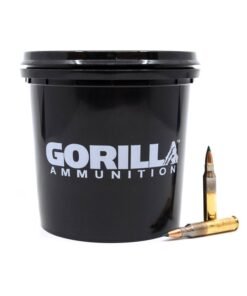
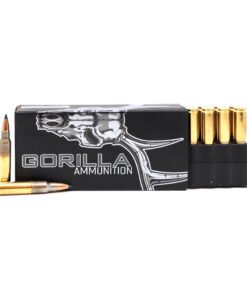
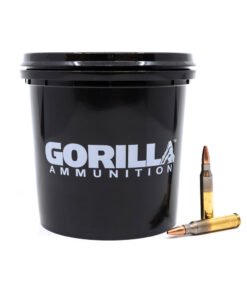
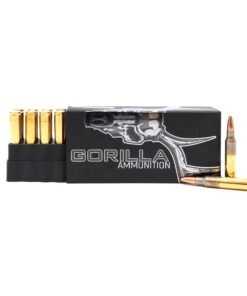
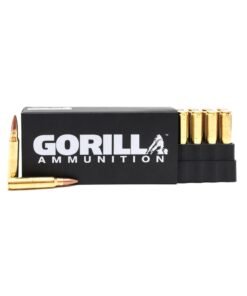
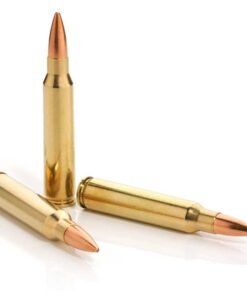
.223 Remington and 5.56 NATO ammunition, in stock. Loaded in house in 20 round boxes and 150 round buckets, with real bullet weights and real availability rather than a permanent backorder button.
Before you order, one thing is worth checking: .223 and 5.56 are not the same cartridge. They share a bullet and case dimensions but not pressure, and the difference decides what is safe in your rifle. The guide below covers that in the first section, then bullet weight, twist rate and what to buy for each job.
Shooting this suppressed? See our 5.56 and .223 suppressors. For everything else we load, browse the caliber index.
.223 or 5.56, and why it matters
This is the most consequential thing on the page, so it goes first.
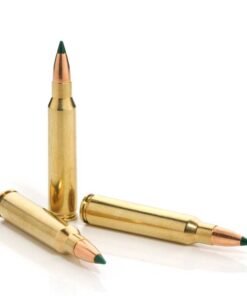
The two cartridges use the same .224 inch bullet and near identical external case dimensions. What differs is chamber and pressure. 5.56 NATO runs higher pressure and uses a chamber with a longer leade, the throat area ahead of the case where the bullet jumps to the rifling.
| Rifle marked | Fire .223? | Fire 5.56? |
|---|---|---|
| 5.56 NATO | yes, safe | yes, safe |
| .223 Wylde | yes, safe | yes, safe |
| .223 Remington only | yes, safe | NO, excess pressure |
Firing 5.56 in a rifle chambered only for .223 raises pressure beyond what the chamber was proofed for, because the shorter leade means the bullet engages the rifling sooner. Read the barrel marking rather than the magazine or the receiver, since that is where the chamber is actually cut.
.223 Wylde is a hybrid chamber that safely accepts both and is often more accurate with match ammunition than a pure 5.56 chamber. If you are specifying a barrel, it is usually the sensible choice.
Bullet weight, and what each one is for
This cartridge covers more jobs than any other on the site, and weight is how you pick.
| Weight | Typical use | Twist needed |
|---|---|---|
| 40 to 55gr | varmint, fast and explosive on impact | 1:9 or faster |
| 55gr FMJ | the default practice and training load | 1:9 or faster |
| 62gr | general purpose, better barrier performance | 1:8 or faster |
| 69 to 77gr match | precision and longer range | 1:8 or 1:7 |
Light bullets leave faster and shed velocity quicker. Heavy bullets start slower, carry better at distance and need more spin to stabilise. That last point is the one people trip over.
Twist rate decides what your rifle can shoot
A barrel that will not stabilise a bullet produces keyholing, oval holes in paper and groups that make no sense.
A 1:9 barrel handles up to roughly 62 grains comfortably and struggles above that. A 1:8 barrel handles everything from 40 to 77 grains and is the most versatile choice. A 1:7 barrel is optimised for heavy 75 and 77 grain match bullets and will still shoot lighter loads perfectly well.
If you do not know your twist, buy 55 or 62 grain, which works in essentially every AR-15 ever built. Then test a heavier load before buying it by the bucket.
Buying by the bucket
.223 and 5.56 is the caliber where bulk buying pays most, because it is the one people shoot in volume. A 150 round bucket costs meaningfully less per round than the equivalent boxes, ships once instead of repeatedly, and stores in a sealed container rather than a shelf of cardboard.
Buy practice ammunition in quantity and specialist loads by the box. And confirm a load runs in your rifle before committing to a case: gas port sizes vary between makers, and a load that cycles perfectly in one AR can be marginal in another.
Store it cool, dry and dark. Moisture is what ruins ammunition, not age, so avoid unheated garages that swing in temperature and keep buckets off concrete floors.
The subsonic question
People ask whether they can shoot .223 or 5.56 subsonic for quiet suppressed shooting. The honest answer is that it works poorly.
A .224 bullet is light, typically 55 to 77 grains. Slowed to 1,050 fps it carries very little energy, and it will not produce enough gas to cycle a semi automatic rifle, so you are hand cycling a rifle that hits softly.
The cartridge that solves this is 300 Blackout, which uses the same AR-15 lower, the same magazines and the same bolt, and carries roughly 500 ft lbs subsonic behind a 220 grain bullet. It exists precisely because 5.56 cannot do this job. See our subsonic ammunition and suppressor range.
One warning that matters if you own both: a 300 Blackout round will chamber in a 5.56 rifle, and firing it can destroy the rifle and injure the shooter. Never let the two share a range bag compartment or a magazine.
Shipping and compliance
We ship within the USA to lawful destinations only, and orders over $300 ship free, which bulk orders generally clear. Ammunition rules vary by state and by city and it remains the buyer's responsibility to know them. See our shipping and delivery page. For chamber and pressure specifications, SAAMI is the industry authority.
Frequently asked questions about .223 and 5.56 ammunition
Is .223 the same as 5.56?
No. They share bullet diameter and case dimensions but not chamber or pressure. A 5.56 chamber safely fires both. A rifle marked .223 Remington only should not be fed 5.56, because the shorter leade raises pressure.
How do I know which my rifle is?
Read the barrel marking, not the receiver or the magazine, since the chamber is cut in the barrel. If it says 5.56 NATO or .223 Wylde, both cartridges are safe.
What is .223 Wylde?
A hybrid chamber that safely accepts both cartridges and is often more accurate with heavy match ammunition than a standard 5.56 chamber. It is usually the best choice when specifying a new barrel.
What bullet weight should I buy?
55 or 62 grain for practice and general use, which works in every common twist rate. 69 to 77 grain match for precision, provided your barrel is 1:8 or 1:7. Light 40 to 55 grain for varmint work.
Will heavy 77 grain bullets work in my rifle?
Only with a 1:8 or 1:7 twist barrel. A 1:9 barrel will usually fail to stabilise them, which shows up as keyholing and groups that make no sense.
Is subsonic .223 worth buying?
Not really. The bullet is too light to carry useful energy at 1,050 fps and will not cycle a semi automatic rifle. For quiet from an AR-15, 300 Blackout is the cartridge designed for it.
Can I fire 300 Blackout in my 5.56 rifle?
Never. A 300 Blackout round will chamber in a 5.56 barrel and firing it can destroy the rifle and injure you. Keep the two separated in storage, in your range bag and in your magazines.
Does buying by the bucket save much?
Yes, and more here than in any other caliber, because .223 is what people shoot in volume. The saving comes from packaging, shipping and handling, and the ammunition itself is identical to the boxed version.