
Handguards. The handguard is where you hold the rifle, where your accessories mount, and on a suppressed build it is also the part that decides whether you can reach the gas block to tune it. That last point is the one people discover too late.
A free floating handguard also keeps everything you bolt on, bipods, lights, hand stops, off the barrel, which matters more once a suppressor has added a pound or more at the muzzle.
See also firearm parts, complete uppers and chassis.
8.6 Blackout Ammo
8.6 Blackout Ammo
8.6 Blackout Ammo
Firearm Parts
Free float, and why it is worth having
An older style drop in handguard clamps to the barrel nut and rests against the barrel and the front sight base. Anything you attach to it, or any pressure you put on it from a bipod or a sling, transmits straight into the barrel and moves your point of impact.
A free floating handguard attaches only at the receiver end and never touches the barrel along its length. Load the fore end however you like and the barrel does not care.
On a suppressed rifle this matters more than usual. You already have a pound or more hanging off the muzzle changing barrel harmonics. Adding a second variable, pressure from whatever your support hand or bipod is doing, makes point of impact unpredictable in a way that is very hard to diagnose.
Length, and the gas block problem
Handguard length is usually chosen for how far forward you like to hold the rifle. On a suppressed build there is a second consideration that outranks it.
If you are running an adjustable gas block, and on a suppressed gas gun you almost certainly should be, you need to reach the adjustment screw. Some blocks adjust from the front and some from the side, and a full length handguard that covers the block entirely means pulling the handguard off every time you want to change the setting.
The options are a handguard with an access port cut for the block, a slightly shorter handguard that leaves the block exposed, or a gas block designed to be adjusted from the front through a small opening. Decide this before you buy, not after you have torqued everything together.
Our firearm parts page covers why the adjustable block matters on a suppressed rifle in the first place.
Diameter and suppressor clearance
Rifle suppressors are typically 1.5 to 2 inches in diameter and 5 to 9 inches long, which means a portion of the can may sit alongside or just past the end of the handguard.
Two practical checks. The handguard's inside diameter has to clear the suppressor if the can is going to be partially shrouded, which some builds do to keep overall length down. And if it does not, the handguard simply needs to end before the can begins, with enough gap that expansion and heat are not an issue.
Heat is worth thinking about generally. A suppressed rifle runs hotter, gas comes back into the receiver area, and the handguard is what your hand is resting on. A vented handguard sheds heat faster, and a hand stop keeps your support hand back from the muzzle, which is not optional with a suppressor fitted.
Attachment standards
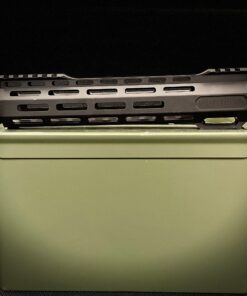
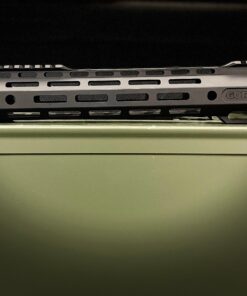
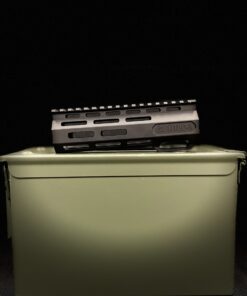
M-LOK is effectively the standard now, and it is what to buy unless you have a specific reason not to. Accessories bolt directly into slots in the handguard, which keeps weight and bulk down, and the range of compatible accessories is enormous.
KeyMod was the competing standard and has largely lost. It still works and accessories still exist, so an existing KeyMod handguard is not a problem, but a new build should be M-LOK.
Picatinny along the full length adds weight and sharp edges, and it is rarely necessary except on top, where a continuous top rail for optics and night vision is genuinely useful. Most modern handguards do exactly that: Picatinny on top, M-LOK on the sides and bottom.
Fitting notes
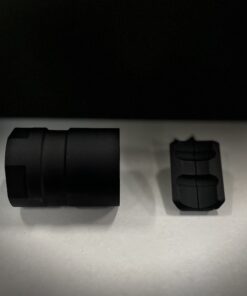
Most free float handguards use a proprietary barrel nut, so the handguard and the nut come together and you cannot usually mix brands.
Torque the barrel nut to specification with the correct wrench, and check that the gas tube passes through cleanly without contact. A gas tube rubbing on the barrel nut is a classic cause of intermittent cycling problems that people spend a long time blaming on ammunition.
Then confirm the handguard genuinely floats: with the rifle assembled, you should be able to slide a strip of paper between the handguard and the barrel along its whole length.
Frequently asked questions about handguards
Do I need a free floating handguard?
For accuracy and consistency, yes, particularly on a suppressed rifle. Pressure from a bipod or sling on a non floating handguard transmits into the barrel and moves your point of impact.
What length should I choose?
Long enough to hold where you want, short enough to reach your gas block. On a suppressed build with an adjustable block, gas block access should decide the length.
M-LOK or KeyMod?
M-LOK. It won the standards contest and has far wider accessory support. An existing KeyMod handguard is fine, but do not start a new build with it.
Will my suppressor fit inside the handguard?
Only if the inside diameter clears it, and only on builds designed to shroud the can. Otherwise the handguard should end before the suppressor begins, with clearance for heat and expansion.
Does a handguard get hot with a suppressor?
Hotter than without one, since a suppressed rifle traps more heat and vents more gas into the receiver area. A vented handguard helps, and a hand stop to keep your support hand back is essential.
Can I use any barrel nut?
Usually not. Most free float handguards use a proprietary nut supplied with them, so the two are bought together.
How do I know it is really free floating?
Slide a strip of paper between the handguard and the barrel along the full length. If it passes freely everywhere, it floats.
Why does my rifle cycle intermittently after a handguard change?
Check the gas tube for contact with the barrel nut. A rubbing or misaligned gas tube is a common cause and is frequently misdiagnosed as an ammunition problem.