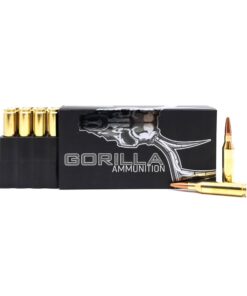
.243 Winchester ammunition, in stock. A .308 case necked down to a .243 inch bullet, and one of the best dual purpose cartridges ever made: fast enough for varmints, adequate for deer, and mild enough that recoil never becomes the reason somebody shoots badly.
It is the cartridge most often recommended to new and recoil sensitive shooters, and it earns that reputation without being a compromise. The guide below covers the two halves of the bullet weight range and the twist rate question that decides which half your rifle can use.
Two cartridges in one
.243 Win splits cleanly by bullet weight, and the two halves do genuinely different jobs.
| Weight | Typical velocity | Built for |
|---|---|---|
| 55 to 70gr | roughly 3,400 to 3,900 fps | varmints, rapid expansion, flat trajectory |
| 80 to 87gr | roughly 3,100 to 3,300 fps | the middle ground, light game |
| 90 to 100gr | roughly 2,900 to 3,000 fps | deer, controlled expansion, deeper penetration |
Light bullets are built to come apart on impact, which is exactly right for varmints and exactly wrong for deer. Heavy bullets use controlled expansion construction that holds together and penetrates. Buying the wrong half of the range is the most common mistake with this cartridge.
Twist rate decides what you can shoot
This is the one specification worth checking before ordering.
Older .243 barrels are commonly 1:10, which stabilises up to roughly 100 grain and struggles beyond it. Newer barrels are often 1:8 or 1:7.5, which handle the long, high ballistic coefficient bullets that make the cartridge competitive at distance.
If you do not know your twist, buy 90 to 100 grain, which works in essentially every .243 ever made. Test anything heavier before buying it in quantity, since a barrel that will not stabilise a bullet produces keyholing and groups that make no sense.
Hunting with .243
It is a proven deer cartridge and has been since 1955. What it asks in return is honest shot placement, because it works through velocity and precision rather than raw mass.
Use a 90 to 100 grain controlled expansion bullet, keep shots inside a range where impact velocity is still high enough to drive expansion, and it performs reliably. Some states set minimum calibers for deer, so check your local regulations, since .243 sits near the line in a few of them.
For varmints, the light 55 to 70 grain loads are spectacular and shoot very flat.
Suppressing .243 Win
It fires a .243 inch bullet, the same diameter as 6mm ARC, so any .30 caliber suppressor runs it safely, as does a dedicated 6mm can. Everything on our 6mm ARC suppressor page applies here.
Expect the usual outcome for a fast supersonic cartridge: hearing safe and considerably more comfortable, but not quiet, because the bullet cracks all the way downrange. .243 is one of the faster cartridges we load, so the crack is pronounced.
Related cartridges
6mm ARC does a similar job from an AR-15 with a shorter, more efficient case. .308 Win is the parent case and carries far more energy for larger game. 6.5 Creedmoor sits between them with better long range performance. Everything we load is in the caliber index.
Frequently asked questions about .243 Winchester
Is .243 enough for deer?
Yes, with a 90 to 100 grain controlled expansion bullet and good shot placement. It has been a popular deer cartridge for seventy years. Check local regulations, since a few states set minimum calibers.
What twist rate do I need?
1:10 handles up to roughly 100 grain and is common on older rifles. 1:8 or faster is needed for the heaviest high BC bullets.
What bullet weight should I buy?
90 to 100 grain for deer, 55 to 70 grain for varmints. The two are built to do opposite things on impact, so match the load to the quarry rather than to the group size.
Can I use a .308 suppressor on .243?
Yes. A .243 bullet is comfortably inside a .30 caliber bore. A dedicated 6mm can is marginally quieter and far less versatile.
Why is recoil so mild?
A light bullet in a moderate case. That combination is why the cartridge is so often recommended to shooters who are developing a flinch with something heavier.
Is .243 or 6mm ARC better?
.243 Win is faster and needs a long action or bolt rifle. 6mm ARC fits an AR-15 and is more efficient with powder. Same bullet diameter, different platforms.
How far will .243 shoot?
Comfortably to 400 yards on deer with the right bullet, and further on paper. Past that, expansion at reduced impact velocity becomes the limit rather than trajectory.
Is there subsonic .243?
No useful factory option. The cartridge is built entirely around velocity, and a light bullet at 1,050 fps carries almost nothing. For quiet shooting, 300 Blackout and 8.6 Blackout are the purpose built answers.