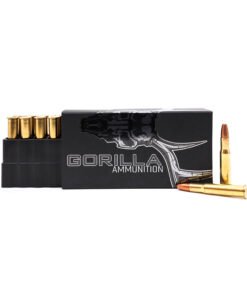
.30-30 Winchester ammunition, in stock. The original smokeless sporting cartridge, introduced in 1895, and still the definitive American woods deer round. It has taken more deer than anything else chambered, and it did it inside 150 yards where most deer are actually shot.
Almost every .30-30 lives in a lever action with a tube magazine, and that single fact shapes everything about the ammunition, including the bullet shape. The guide below explains why, and what it means for the range you can realistically use.
Why .30-30 bullets are flat nosed
In a tube magazine, cartridges sit nose to primer in a line. Under recoil, the tip of one bullet presses against the primer of the round in front of it, and a pointed tip is a genuinely bad idea in that arrangement.
So .30-30 ammunition has always used flat or round nosed projectiles. That is a safety requirement rather than a design preference, and it is also the cartridge's main ballistic limitation: a blunt bullet has a poor ballistic coefficient, sheds velocity quickly and drops steeply.
Modern flexible polymer tip bullets solve this properly. The tip is soft enough to be safe against a primer and pointed enough to improve ballistic coefficient meaningfully, which extends usable range. If your rifle groups them well, they are a real upgrade over traditional flat nose loads.
Bullet weight
| Weight | Typical velocity | Best for |
|---|---|---|
| 150gr | roughly 2,300 fps | slightly flatter, lighter recoil, deer |
| 170gr | roughly 2,200 fps | the traditional choice, deeper penetration, black bear |
The range is narrow because the cartridge is well settled. 170 grain is the classic loading and penetrates better on larger animals. 150 grain shoots marginally flatter and recoils a little less. Either works on deer at woods ranges.
Range, honestly
Treat 150 yards as the practical ceiling with traditional flat nose ammunition, extended somewhat with flexible tip loads. The limit is trajectory rather than energy: the blunt bullet slows quickly and drops steeply, so range estimation errors turn into misses faster than with a flatter shooting cartridge.
That has never been a real problem, because .30-30 rifles are woods rifles. They are light, short, fast to bring up and fast to work, which is exactly what shooting in cover asks for.
Suppressing a .30-30
It fires a .308 inch bullet, so any .30 caliber suppressor runs it safely. Lever actions suppress unusually cleanly: no gas system venting at your face, no buffer tube adding length behind the action, and nothing to tune. Every load cycles, because you cycle it.
The obstacle is the muzzle. Most factory lever guns are not threaded, so that is a gunsmithing job or a barrel with threads from the outset.
Expect hearing safe rather than quiet, since .30-30 is supersonic. For a genuinely quiet lever gun, 8.6 Blackout lever actions now exist and throw a 342 grain subsonic .338 bullet with no sonic crack at all. Our lever action guide covers that comparison.
Related cartridges
Same .308 bullet with far more reach: .308 Win and .30-06 Springfield. Heavier woods cartridge in the same kind of rifle: .45-70 Govt. Everything we load is in the caliber index.
Frequently asked questions about .30-30 Winchester
Why are .30-30 bullets flat nosed?
Tube magazines stack rounds nose to primer, and a pointed tip pressing on a primer under recoil is a safety problem. Flexible polymer tips are the modern solution that is both safe and more aerodynamic.
How far will a .30-30 shoot?
Around 150 yards is the sensible practical limit with traditional ammunition, further with flexible tip loads. Trajectory is what limits it, not energy.
Which bullet weight should I buy?
170 grain for the traditional choice and deeper penetration, 150 grain for slightly flatter trajectory and lighter recoil. Both work well on deer at woods ranges.
Can I use pointed bullets in my lever action?
Not conventional pointed bullets in a tube magazine. Flexible polymer tipped designs are made specifically to be safe in tube magazines and are the only pointed option to use.
Is .30-30 still worth buying?
For woods deer inside 150 yards, absolutely. Light fast handling rifles, affordable ammunition and 130 years of proof behind it.
Can I suppress a .30-30?
Yes, with any .30 caliber can, provided the muzzle is threaded, which most factory lever guns are not. Lever actions suppress very cleanly since there is no gas system.
Is .30-30 the same as .308?
They share a .308 inch bullet and nothing else. Different cases, pressures and velocities, and they are not interchangeable in any rifle.
Is it enough for black bear?
At woods ranges with a 170 grain load, yes, and it has been used for exactly that for generations. Shot placement and penetration matter more than raw energy here.