
Upper receivers and upper assemblies. This shelf is the upper half of an AR at various stages of assembly, for people building rather than buying finished. If you want one assembled and ready to pin on, go to complete uppers instead.
Building your own upper is worthwhile when you want a specific barrel, a specific gas system and a handguard that suits how you actually shoot, rather than accepting somebody else’s combination. The guide below covers the decisions in the order that matters.
See also upper parts, barrels, handguards and firearm parts.
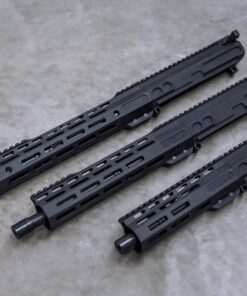
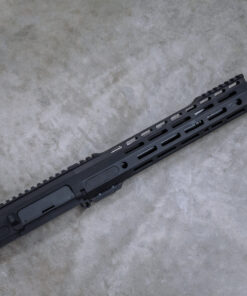
8.6 Blackout Ammo
8.6 Blackout (ALL)
Stripped, partial or complete
| You buy | You still need | Suits |
|---|---|---|
| Stripped upper receiver | everything: barrel, nut, handguard, gas system, BCG, charging handle | full control, most work |
| Assembled upper, no BCG | bolt carrier group and charging handle | common and often the best value |
| Complete upper | nothing, pin it on | fastest route, least risk |
Read listings carefully, because "complete" is used loosely. The bolt carrier group is the item most often excluded and the most expensive to add, and on some cartridges the bolt is not a generic part.
The build order that avoids rework
Decide in this sequence and nothing you buy will be made redundant by a later choice.
1. Cartridge. Everything else follows from it, including whether a standard 5.56 bolt will do. 300 Blackout uses one. 6.5 Grendel, 6mm ARC and 6.8 SPC do not.
2. Barrel twist. Cut into the barrel and uncorrectable. 1:7 or 1:8 for 300 Blackout, 1:5 for 338 ARC, 1:8 for 6mm ARC and 6.5 Grendel.
3. Barrel length and gas length. These go together. Pistol length gas for very short barrels, carbine for 16 inch, mid length for 16 to 18 inch. A mismatch produces a rifle that is badly gassed before a suppressor is anywhere near it.
4. Gas block. Adjustable, if this upper will ever be shot suppressed. Fitting one later usually means removing the handguard from a finished build.
5. Handguard. Free floating, long enough to hold where you like, short enough to reach the gas block adjustment. Our handguards page covers that conflict.
6. Muzzle thread. Match it to your suppressor mount before the barrel ships, not after.
Assembly points that cause problems
Barrel nut torque. To specification, with the correct wrench, and aligned so the gas tube passes cleanly. A gas tube touching the barrel nut causes intermittent cycling failures that get blamed on ammunition for months.
Gas block alignment. The port in the block must line up with the port in the barrel. Misalignment restricts gas and produces a rifle that short strokes, especially with subsonic loads that have little gas to spare.
Headspace. Barrel and bolt are a matched system. Buying them separately from different makers is where headspace should be checked rather than assumed.
Free float check. With everything assembled, a strip of paper should slide between handguard and barrel along the whole length.
Why suppressed builds need more care
A suppressor raises pressure at the muzzle, which travels back down the gas tube and makes the rifle cycle on more gas than it was set up for. Subsonic ammunition pulls the opposite way by producing less gas to begin with.
A build that is over gassed from the start becomes unpleasant with a can fitted: violent ejection, gas in the face, fast fouling and worse felt recoil. A build tuned only for supersonic use may not cycle subsonics at all.
This is why the adjustable gas block appears at step 4 rather than as an afterthought. It is the one component that lets you sit correctly in the middle, and it costs far less to fit during assembly than after.
Frequently asked questions about uppers
Do uppers require any paperwork?
No. The lower receiver is the serialised component, so upper receivers and assemblies ship as ordinary parts. Rules on the assembled rifle's configuration still apply.
Is building an upper cheaper than buying one complete?
Parts cost is usually similar. Building wins on control over each component and loses on tools, time and the cost of the first mistake.
What tools do I need?
At minimum a vice with an upper receiver block, an armourer's wrench and a torque wrench. Guessing at barrel nut torque is the most common assembly error.
Does the bolt carrier group come with the upper?
Often not. Check the listing, and check whether your cartridge needs a specific bolt face. 300 Blackout uses a standard 5.56 bolt, while 6.5 Grendel and 6mm ARC do not.
What gas length should I use?
Pistol length for very short barrels, carbine for 16 inch, mid length for 16 to 18 inch. Matching gas length to barrel length is what keeps the rifle correctly gassed.
Why does my build short stroke with subsonics?
Usually gas block alignment or too small a gas port, both of which matter more with subsonic loads that produce little gas. Check the block is aligned with the barrel port before assuming the ammunition is at fault.
Do I need to check headspace?
If you bought barrel and bolt separately from different makers, yes. A matched barrel and bolt from one source is normally set correctly.
Can I reuse my 5.56 upper parts for 300 Blackout?
The bolt, carrier and charging handle all carry over, which is why the conversion is popular. Only the barrel changes, and with it the gas system if the length differs.