9mm ammunition, in stock. The most shot cartridge in the world, and the one where a single choice decides whether your suppressed pistol is quiet or merely quieter: bullet weight. 147 grain is subsonic. 115 grain is not. That is the whole decision, and it is covered first below.
We load 9mm for practice, training and suppressed shooting, listed with real weights and real availability rather than a permanent backorder button.
Suppressing it? See our 9mm suppressors. Buying pistol calibers together? See 9mm and .380 or .45 ACP, or browse the caliber index.



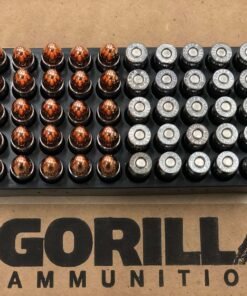
The weight decision, and why it is the only one that matters
9mm sits right on the sound barrier, which makes it unusually sensitive to bullet weight. Heavier bullets leave slower, and slower is what keeps you under roughly 1,125 fps.
| Weight | Typical velocity | Subsonic? | Best for |
|---|---|---|---|
| 115gr | roughly 1,150 to 1,200 fps | no, will crack | cheap practice, unsuppressed |
| 124gr | roughly 1,100 to 1,150 fps | marginal, temperature dependent | general purpose |
| 147gr | roughly 950 to 1,000 fps | yes, comfortably | suppressed shooting |
| 158gr and heavier | roughly 900 to 950 fps | yes, with margin | maximum quiet |
Read the 124 grain row carefully, because it is the one that catches people out. A 124 grain load sitting at 1,120 fps is subsonic on a cold morning and supersonic on a warm afternoon, since the speed of sound rises with temperature. You get a crack on some shots and not others, which is the most irritating possible outcome from a suppressed pistol.
If quiet matters, buy 147 grain and stop thinking about it. If you are shooting unsuppressed practice, buy 115 grain because it is the cheapest.
What each weight actually feels like
Beyond the sound barrier question, weight changes the character of the recoil.
115 grain is fast and snappy, with a sharp impulse that returns quickly. It is the cheapest to buy and the most common practice load.
124 grain is the middle ground and what many duty and defensive loads use. It splits the difference on recoil and on everything else.
147 grain is a slower, heavier push rather than a snap. Many shooters find it easier to control and to shoot accurately, and it happens to be the subsonic option, which is a convenient coincidence.
Suppressed 9mm, and what to expect
With 147 grain ammunition and a good can, a suppressed 9mm is genuinely quiet. Not silent, but quiet enough that the slide cycling becomes a significant part of what you hear.
Two things worth knowing. First, most 9mm pistols use a tilting barrel and will need a booster in the suppressor to cycle at all, which is covered on our 9mm suppressor page. Second, subsonic 147 grain ammunition produces slightly less energy to work the action, so a very heavy can on a light pistol can occasionally cause short stroking.
A 9mm carbine is quieter again, because the longer barrel burns more powder before the gas reaches the suppressor and there is no action venting back at your face.
Buying in volume
9mm is the caliber people shoot most, so it is the one where bulk buying pays. The saving comes from packaging, shipping and handling rather than from a different product, and orders over $300 ship free.
Buy practice ammunition in quantity and defensive or specialist loads by the box. Confirm a load runs reliably in your specific pistol before committing to a case, since recoil spring weights vary and some pistols are fussier with light or heavy loads than others.
Store it cool, dry and dark. Moisture ruins ammunition, not age, so avoid unheated garages that swing in temperature and keep boxes off concrete floors.
9mm against the alternatives
Against .45 ACP: 9mm gives you higher capacity, cheaper practice and flatter trajectory. .45 is naturally subsonic in every standard loading, runs at lower pressure and is generally quieter suppressed. If maximum quiet is the goal, .45 has the edge. If volume and capacity matter, 9mm wins.
Against .380 ACP: 9mm carries considerably more energy from the same bullet diameter. .380 is the compact carry option and suppresses very well because it is subsonic with low gas volume.
Against .357 SIG: .357 SIG is faster and flatter and comfortably supersonic, so it will crack no matter what you fit. 9mm in 147 grain is the quiet one.
Shipping and compliance
We ship within the USA to lawful destinations only, and orders over $300 ship free. Ammunition rules vary by state and by city and remain the buyer's responsibility. See our shipping and delivery page, and SAAMI for cartridge specifications.
Frequently asked questions about 9mm ammunition
Is 9mm subsonic?
It depends entirely on weight. 147 grain and heavier is comfortably subsonic. 115 grain is supersonic. 124 grain sits right on the line and can go either way with temperature.
What weight should I buy for a suppressor?
147 grain, without hesitation. It is well under the sound barrier with margin for a hot day, which is exactly what you want from a suppressed pistol.
Why does my 124 grain ammunition sometimes crack?
Because it is sitting on the boundary. The speed of sound rises with temperature, so a load that is subsonic in cool weather crosses over on a warm day. Move to 147 grain to remove the variable.
What is the cheapest 9mm to practise with?
115 grain, which is the highest volume loading and therefore the lowest cost per round. Buy it by the bucket if you shoot regularly.
Will 147 grain cycle my pistol?
Almost always, though subsonic loads produce slightly less energy to work the action. If your pistol short strokes with a heavy suppressor fitted, a lighter recoil spring usually resolves it.
Is 9mm or .45 quieter suppressed?
.45 ACP, generally. It is subsonic in every standard loading and runs at lower pressure, so there is less blast for the can to handle. Heavy 147 grain 9mm is close behind.
Does a longer barrel make 9mm louder?
Quieter, in fact. More powder burns inside the barrel, so less unburnt propellant reaches the suppressor. A suppressed 9mm carbine is noticeably quieter than the same round from a pistol.
What is the difference between 9mm and 9x19?
Nothing. 9mm Luger, 9x19 and 9mm Parabellum are three names for the same cartridge. Avoid confusing it with 9mm Makarov or .380, which are different rounds.