9mm and .380 ACP together, in one place. These two cartridges share a bullet diameter and almost nothing else, which is exactly why people mix them up and occasionally try to feed one to the other. They are not interchangeable, and the first section below explains why in plain terms.
This shelf exists for buyers stocking both, usually because there is a 9mm at the range and a .380 in a pocket pistol. If you want one caliber on its own, go straight to 9mm ammunition or .380 ACP ammunition.
Suppressing either? Both run on the same cans: see 9mm suppressors and .380 suppressors. Everything we load is in the caliber index.



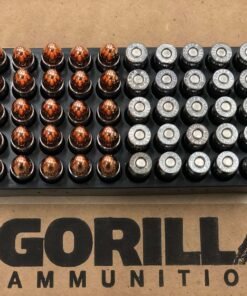
Same bullet, different cartridge
Both fire a .355 inch bullet. That is where the similarity ends, and the difference is not cosmetic.
| 9mm Luger | .380 ACP | |
|---|---|---|
| Also called | 9x19, 9mm Parabellum | 9mm Short, 9mm Kurz, 9x17 |
| Bullet | .355 | .355 |
| Case length | 19mm | 17mm |
| Typical bullet weight | 115 to 147gr | 90 to 100gr |
| Typical energy | roughly 350 to 400 ft lbs | roughly 190 to 220 ft lbs |
| Pressure | higher | much lower |
| Action type | usually locked breech | often simple blowback |
They are not interchangeable. A .380 round is shorter and lower pressure and will not function correctly in a 9mm, and a 9mm round will not chamber in a .380. Keep them in separate containers and check the headstamp when you load, particularly if you own both.
The energy row is the honest summary: 9mm carries roughly double what .380 does from the same bullet diameter. .380 exists because it fits in smaller, lighter pistols, not because it does anything better.
Which one is quiet, and why both suppress well
This is where the two converge, and it is the reason they sit together on a site like ours.
.380 ACP is subsonic in essentially every factory loading, at roughly 900 to 1,000 fps. It also produces very little gas, because the case is small and the powder charge modest. That combination is close to ideal for a suppressor, and a suppressed .380 is remarkably soft and quiet.
9mm depends entirely on bullet weight. 147 grain is comfortably subsonic at roughly 950 to 1,000 fps. 115 grain is supersonic and will crack. 124 grain sits on the boundary and changes with the weather, which is the most annoying possible result.
So if quiet is the goal: buy .380 as it comes, and buy 9mm in 147 grain.
One suppressor covers both
Because they share a .355 inch bullet, any 9mm rated suppressor runs .380 safely, and so does any larger pistol can. There is no reason to buy two.
In fact the sensible purchase for someone who owns several handguns is a .45 rated can, which covers .45 ACP, 10mm, .40, .357 SIG, 9mm and .380 on a single tax stamp. You swap the booster piston to match each pistol's thread pitch, commonly 1/2x28 on 9mm and 13.5x1 LH on many imports.
One difference worth knowing: most 9mm pistols use a tilting barrel and need a booster in the can to cycle at all, while many .380 pistols are fixed barrel blowback designs that work better with a solid spacer instead. Most suppressors ship with both parts.
Choosing between them
Buy 9mm if you want capacity, cheap practice ammunition, meaningful energy and the widest choice of pistols and accessories. It is the most shot cartridge in the world for good reasons.
Buy .380 if the pistol has to be genuinely small and light, or if you want the softest shooting suppressed handgun available and are not worried about energy.
Most people who own both use the 9mm for range work and defence and the .380 for deep concealment, which is exactly the split the two cartridges were designed for.
Buying in volume and storing it
9mm is the caliber worth buying in quantity, since it is the one you will shoot most and the savings on packaging, shipping and handling are real. Orders over $300 ship free. .380 is usually bought in smaller quantities simply because pocket pistols do not get shot as much.
Store both cool, dry and dark. Moisture is what degrades ammunition rather than age, so keep it out of unheated spaces that swing in temperature and off concrete floors. Label containers clearly, which matters more than usual when two similar looking cartridges live in the same cabinet.
Shipping and compliance
We ship within the USA to lawful destinations only, and orders over $300 ship free. Ammunition rules vary by state and by city and remain the buyer's responsibility. See our shipping and delivery page, and SAAMI for cartridge specifications.
Frequently asked questions about 9mm and .380 ammunition
Can I shoot .380 in a 9mm pistol?
No. The case is shorter and the pressure much lower, so it will not headspace or function correctly. They are different cartridges that happen to share a bullet diameter.
Can I shoot 9mm in a .380 pistol?
No. The 9mm case is longer and will not chamber, and the pressure would be far beyond what a .380 pistol is built for.
Is .380 the same as 9mm Short?
Yes. .380 ACP, 9mm Short, 9mm Kurz and 9x17 are all the same cartridge. 9mm Luger, 9x19 and 9mm Parabellum are the larger one.
Which is quieter suppressed?
.380, marginally, because it is subsonic in every loading and produces very little gas. Heavy 147 grain 9mm is close behind and carries roughly double the energy.
Can one suppressor run both?
Yes. Both fire a .355 inch bullet, so any 9mm rated can covers both. A .45 rated can covers these plus .45 ACP, 10mm, .40 and .357 SIG on one stamp.
Do I need a booster for both?
For most 9mm pistols yes, since they use tilting barrels. Many .380 pistols are fixed barrel blowback designs and work better with a solid spacer. Most suppressors include both parts.
Which 9mm weight should I buy?
147 grain for suppressed shooting, since it is reliably subsonic. 115 grain for cheap unsuppressed practice. Avoid relying on 124 grain if you want consistent quiet, because it sits on the sound barrier.
Is .380 powerful enough?
It carries roughly half the energy of 9mm, which is why it exists in small pistols rather than large ones. It is a close range cartridge and choosing it is a trade of power for concealability.