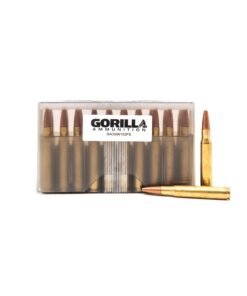
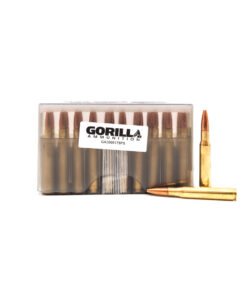
.30-06 Springfield ammunition, in stock. Adopted in 1906 and still one of the most capable general purpose hunting cartridges made. .30-06 fires the same .308 inch bullets as .308 Winchester from a larger case, which buys roughly 100 to 200 fps and, more usefully, the ability to push heavier bullets than a short action cartridge comfortably can.
The guide below covers where it genuinely beats .308, what bullet weight to choose for the job, and what to expect when suppressing a long action rifle.
Compare with .308 Win, or see .30 caliber suppressors, which run both. Everything we load is in the caliber index.
.30-06 against .308
These two fire identical bullets, so the difference is entirely case capacity and action length.
| .30-06 Springfield | .308 Winchester | |
|---|---|---|
| Bullet | .308 | .308 |
| Action | long | short |
| Typical 180gr velocity | roughly 2,700 fps | roughly 2,550 fps |
| Heavy bullets, 200gr+ | comfortable | possible but cramped |
| Recoil | more | less |
| Rifle weight | heavier action | lighter, shorter |
| Ammunition cost | higher | lower |
With standard 150 to 168 grain bullets the gap is modest, perhaps 100 fps, and not worth arguing about. Where .30-06 pulls genuinely ahead is with heavy projectiles: 200 and 220 grain loads that a .308 case can technically fire but cannot drive well, because seating a long bullet in a short case eats the powder space.
So the honest position: for deer at normal ranges, .308 does everything and is cheaper. For elk, moose, heavy bone or anywhere you want a 200 grain bullet moving properly, .30-06 is the better cartridge and always has been.
Bullet weight and what to buy
| Weight | Typical velocity | Best for |
|---|---|---|
| 150gr | roughly 2,900 fps | deer, flatter trajectory, lighter recoil |
| 165 to 168gr | roughly 2,800 fps | the all round choice, deer through black bear |
| 180gr | roughly 2,700 fps | elk and larger, the classic .30-06 weight |
| 200 to 220gr | roughly 2,400 to 2,550 fps | heavy game, deep penetration, where .30-06 earns its keep |
180 grain is the weight most associated with the cartridge and a sensible default for anything larger than deer. Construction matters as much as weight: a bonded or partition style bullet holds together on heavy bone where a conventional cup and core design can come apart.
Nearly all .30-06 barrels are cut 1:10, which stabilises this entire range, so twist rate is not a decision you need to make here.
Suppressing a .30-06
It fires a .308 inch bullet, so any .30 caliber suppressor runs it safely, and everything on that page applies. Check the manufacturer's cartridge rating covers .30-06, which most .308 rated cans do since the pressures are comparable, unlike the step up to a magnum.
Expect the usual outcome: hearing safe and far more comfortable rather than quiet, since the bullet is comfortably supersonic and cracks all the way downrange. The recoil reduction is the benefit people notice most on a cartridge this size, commonly 20 to 30 percent, which for many shooters removes a flinch and improves their groups.
Two practical notes for a long action rifle. Barrels are usually 22 to 24 inches, so adding a can makes for a long rifle and a compact suppressor is worth considering. And expect roughly 20 to 40 fps more muzzle velocity suppressed, plus a point of impact shift, so zero with the can fitted and model it in our ballistics calculator.
Why it is still worth owning
.30-06 has been declared obsolete roughly once a decade for a century, and it keeps not being. The reasons are practical rather than sentimental.
It handles the widest useful range of bullet weights of any common .30 caliber cartridge, from 150 grain deer loads to 220 grain heavy game projectiles, in one rifle. Ammunition is available in every shop that sells rifle ammunition anywhere in the world. And it does all of it without magnum pressure, magnum recoil or magnum barrel wear.
What it gives up is action length and weight, and the fact that a short action .308 does 80 percent of the job in a lighter rifle. That is a real trade, and it is the reason .308 outsells it.
Shipping and compliance
We ship within the USA to lawful destinations only, and orders over $300 ship free. Ammunition rules vary by state and by city and remain the buyer's responsibility. See our shipping and delivery page, and SAAMI for cartridge specifications.
Frequently asked questions about .30-06 ammunition
Is .30-06 better than .308?
With heavy bullets, yes. The larger case drives 200 and 220 grain projectiles properly where a short .308 case cannot. With standard 150 to 168 grain loads the difference is roughly 100 fps and rarely matters.
What bullet weight should I buy?
150 grain for deer and flatter trajectory, 165 to 180 grain as an all round choice, 200 grain and up for elk, moose or heavy bone where penetration is the priority.
Is .30-06 good for elk?
Yes, and it is one of the classic choices. Use a 180 grain or heavier bonded or partition style bullet built to hold together at close range impact velocities.
Can I use a .308 suppressor on .30-06?
Yes, both fire .308 inch bullets and run at comparable pressures. Confirm the manufacturer lists .30-06 in the cartridge rating, which most .308 rated cans do.
What twist rate does .30-06 need?
1:10 is effectively universal and stabilises everything from 150 to 220 grain. Unlike the Blackout cartridges, twist is not something you need to check.
Does .30-06 recoil much more than .308?
Noticeably, particularly with heavy bullets, though it is a slower push rather than a sharp snap. A suppressor removes a meaningful share of it, which is one of the better reasons to fit one.
Is subsonic .30-06 available?
Not in any useful factory form, and the cartridge was designed around the opposite. For genuinely quiet shooting, 300 Blackout and 8.6 Blackout are the purpose built answers, and a .30 caliber can covers .30-06 and 300 Blackout both.
Why do people still buy .30-06?
Bullet weight range, worldwide availability and the fact that it does everything short of magnum work without magnum costs. It has been called obsolete for a century and keeps outliving the claim.