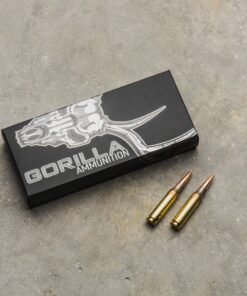
.260 Remington ammunition, in stock. .260 Rem is the cartridge that did what 6.5 Creedmoor is famous for, about ten years earlier, and never got the credit. It fires the same .264 inch bullets at effectively the same velocities from the same short action, and it does so from a .308 case that has been in production since 1952.
If you own a .260, this page is about feeding it well. If you are choosing between .260 and 6.5 Creedmoor, the guide below gives you the honest comparison, which is closer than the internet suggests and comes down to brass and availability rather than ballistics.
Compare with 6.5 Creedmoor and .308 Win, or browse the caliber index.
What .260 Remington is
Take a .308 Winchester case and neck it down to accept a .264 inch bullet. That is the whole design, and it is a good one. You get the long, slender, high ballistic coefficient bullets that make 6.5mm cartridges shoot so well, in a case that fits every short action rifle already built for .308.
Introduced in 1997, it was a wildcat before that as the 6.5-08. It has been quietly excellent for nearly thirty years, and it lost the popularity contest to 6.5 Creedmoor for reasons that have very little to do with performance.
Against 6.5 Creedmoor, without the marketing
Ballistically these two are near enough identical. Same bullet diameter, same bullet weights, velocities within a few tens of feet per second, same short action, same recoil. Anyone claiming a meaningful ballistic advantage either way is selling something.
| .260 Remington | 6.5 Creedmoor | |
|---|---|---|
| Bullet | .264 | .264 |
| Typical 140gr velocity | roughly 2,700 to 2,750 fps | roughly 2,690 to 2,750 fps |
| Case | .308 necked down | purpose designed |
| Neck length | shorter | longer, seats long bullets better |
| Ammunition availability | limited | everywhere |
| Rifle availability | limited, mostly older | extensive |
| Brass from other cases | yes, from .308 | no |
Where 6.5 Creedmoor genuinely wins is the neck. It is longer, which lets you seat heavy high BC bullets without them intruding into powder space or past the magazine length. With the heaviest match projectiles that is a real advantage in a factory rifle.
Where 6.5 Creedmoor wins overwhelmingly is availability, and that is what decided it. Every maker loads Creedmoor, every shop stocks it, and every new short action precision rifle is offered in it.
The honest summary: if you are buying a new rifle, buy 6.5 Creedmoor for the ecosystem. If you already own a .260, you own a cartridge that shoots just as well, and you should keep it.
Bullet weight
| Weight | Best for |
|---|---|
| 120 to 130gr | flatter trajectory, lighter game, faster follow up |
| 140gr | the standard, best balance of BC and velocity |
| 142 to 147gr | maximum wind performance at long range |
140 grain is the default here for the same reason it is in 6.5 Creedmoor: it is where ballistic coefficient and velocity balance best. Watch overall length with the heaviest bullets, since the shorter neck means they can intrude on powder capacity or exceed magazine length in some rifles.
Most .260 barrels are cut 1:8, which stabilises the full range. Some older rifles are 1:9, which handles 140 grain comfortably and can struggle with the heaviest match bullets. Worth checking before buying a quantity of 147s.
Handloading, where .260 has a real edge
This is the one place .260 clearly beats its rival. Because the case is simply .308 Winchester necked down, brass is straightforward to form from .308 or 7.62x51 cases, which are among the most abundant on earth.
That matters if factory .260 ammunition is scarce where you live, which it often is. A shooter who reloads is largely insulated from the availability problem that pushed everyone toward the Creedmoor, and can feed a .260 indefinitely from .308 brass.
Sort by headstamp, trim to consistent length, and check case capacity when switching brands, since .308 brass varies in wall thickness between makers and that changes pressure. Components are on our projectiles and brass shelf.
Hunting with .260
It is an excellent deer cartridge and always has been. Mild recoil, flat enough trajectory for any realistic range, and .264 bullets that penetrate well for their weight.
As with any cartridge, construction matters more than weight. Match bullets are built for accuracy rather than expansion and often pass straight through game. Choose a controlled expansion hunting projectile, in 140 grain for deer sized animals, heavier if you expect to hit bone.
Suppressing .260
.260 Rem fires a .264 bullet, so any .30 caliber suppressor runs it safely, as does a dedicated 6.5 can. Since 6.5 Creedmoor uses the same bullet, everything on our 6.5 Creedmoor suppressor page applies here without modification.
Expect the usual: hearing safe rather than quiet, since the bullet is supersonic, plus a zero shift and roughly 15 to 40 fps more muzzle velocity. Model it in our ballistics calculator.
Shipping and compliance
We ship within the USA to lawful destinations only, and orders over $300 ship free. Ammunition rules vary by state and by city and remain the buyer's responsibility. See our shipping and delivery page, and SAAMI for cartridge specifications.
Frequently asked questions about .260 Remington ammunition
Is .260 Remington the same as 6.5 Creedmoor?
No, they are different cartridges and are not interchangeable. They fire the same .264 bullets at near identical velocities from the same short action, which is why they perform so similarly.
Which is better, .260 or 6.5 Creedmoor?
Ballistically they are a wash. 6.5 Creedmoor has a longer neck that seats heavy bullets better, and far greater ammunition and rifle availability. If you already own a .260, you are not giving anything up.
Can I make .260 brass from .308 cases?
Yes. .260 Remington is simply .308 Winchester necked down to .264, so forming brass from .308 or 7.62x51 is straightforward. This is the cartridge's real advantage for handloaders.
What bullet weight should I use?
140 grain for most purposes, balancing ballistic coefficient against velocity. Check overall length with the heaviest 147 grain match bullets, since the shorter neck can push them into powder space or past magazine length.
What twist rate does .260 need?
1:8 is standard and handles everything. Older rifles are sometimes 1:9, which is fine with 140 grain and can struggle with the heaviest match projectiles.
Is .260 good for deer?
Very. Mild recoil, flat trajectory and good penetration for the bullet weight. Use a controlled expansion hunting bullet rather than a match projectile.
Can I use a 6.5 Creedmoor suppressor on .260?
Yes. Both fire .264 bullets, so any 6.5 rated can works, and so does any .30 caliber suppressor. Nothing about the suppressor choice differs between the two cartridges.
Why did 6.5 Creedmoor become more popular?
Marketing, timing and the ecosystem that followed, rather than ballistics. Once every maker chambered rifles and loaded ammunition for it, availability decided the outcome.