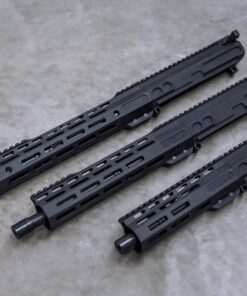
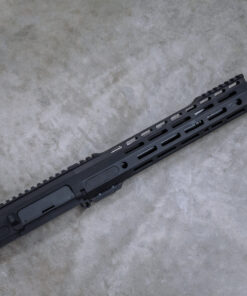
Complete uppers, assembled and ready to pin on. A complete upper is the fastest way to change what an AR is. Because the lower receiver is the serialised part, swapping the upper means one rifle can become a suppressed 300 Blackout on Saturday and a 5.56 carbine on Sunday, using the same lower, the same trigger and the same stock.
It also removes the part of a build where mistakes cost money. The barrel twist, gas length, thread pitch and headspace are already correct and already checked.
See also upper receivers and components, firearm parts and complete firearms.
8.6 Blackout Ammo
8.6 Blackout (ALL)
What a complete upper includes
Terminology varies between sellers, so check before ordering. A genuinely complete upper is barrel, upper receiver, handguard, gas system and muzzle device assembled together. Some include the bolt carrier group and charging handle and some do not, and those two are not trivial purchases.
The bolt in particular matters, because it has to match the cartridge. 300 Blackout uses a standard 5.56 bolt, which is why that conversion is so easy. 6.5 Grendel, 6mm ARC and 6.8 SPC each need their own bolt face, so an upper without a bolt is an incomplete purchase for those cartridges.
Why the upper swap is the AR's best feature
One serialised lower can host several uppers, and each combination behaves like a different rifle.
| Upper | Turns your rifle into | Bolt needed |
|---|---|---|
| 300 Blackout, 12 to 16in | a quiet suppressed subsonic rifle | standard 5.56 bolt |
| 5.56 or .223, 16in | a cheap high volume carbine | standard 5.56 bolt |
| 6mm ARC or 6.5 Grendel, 18 to 20in | a long range AR | Grendel bolt face |
| 338 ARC | heavier subsonic from an AR-15 | cartridge specific |
The 300 Blackout case is the one worth highlighting. Same lower, same magazines, same bolt, and the only change is the upper. It is the single easiest meaningful upgrade in the AR world, and it is why so many people end up with a suppressed Blackout upper alongside a 5.56 one.
What to check before buying
Twist rate first, because it is cut into the barrel and cannot be corrected. 1:7 or 1:8 for 300 Blackout, 1:5 for 338 ARC, 1:8 for 6mm ARC and 6.5 Grendel, 1:7 to 1:9 for 5.56.
Gas system length should match the barrel: pistol length for very short barrels, carbine for 16 inch, mid length for 16 to 18 inch. A mismatch shows up as a rifle that is over or under gassed before you have even fitted a suppressor.
Adjustable gas block, ideally already fitted. If the upper will be shot suppressed, this is the difference between a rifle that runs cleanly and one that vents gas in your face. Retrofitting means pulling the handguard off a finished upper.
Thread pitch at the muzzle, so it matches your suppressor mount. Commonly 1/2x28 on 5.56 and many 300 Blackout barrels, 5/8x24 on larger calibers.
The safety point about mixed uppers
If you own a 300 Blackout upper and a 5.56 upper for the same lower, you also own the most dangerous magazine mix in the AR world.
A 300 Blackout round will chamber in a 5.56 barrel. Firing it can destroy the rifle and injure the shooter, because a .308 bullet is being driven into a .224 bore. It happens, and it happens to experienced people who grabbed the wrong magazine.
Colour code or label magazines, store the two calibers in separate containers, and check every magazine before you load it. This is the one rule on this page that is not about performance.
Frequently asked questions about complete uppers
Do I need any paperwork to buy an upper?
No. The lower receiver is the serialised part, so uppers ship like any other component. Configuration rules such as barrel length still apply to the assembled rifle.
Will any upper fit my lower?
AR-15 uppers fit AR-15 lowers, and AR-10 pattern uppers fit their matching lowers, but AR-10 patterns are not standardised between makers. For 8.6 Blackout and .308 sized cartridges, check the specific pattern.
Does a complete upper include the bolt carrier group?
Sometimes. Check the listing, because it is a significant cost, and because the bolt has to match the cartridge. 300 Blackout uses a standard 5.56 bolt, while 6.5 Grendel and 6mm ARC need their own.
Can I put a 300 Blackout upper on my 5.56 lower?
Yes, and it is the easiest worthwhile conversion in the AR world. Same lower, same magazines, same bolt. Just never mix the ammunition, since a 300 Blackout round will chamber in a 5.56 barrel with dangerous results.
What twist rate should the upper have?
1:7 or 1:8 for 300 Blackout, 1:5 for 338 ARC, 1:8 for 6mm ARC and 6.5 Grendel, 1:7 to 1:9 for 5.56 depending on bullet weight. Verify before buying, since it cannot be changed afterwards.
Do I need an adjustable gas block?
If the upper will be shot suppressed, effectively yes, and it is far easier to buy one already fitted than to add it later.
Will I need to re zero after swapping uppers?
Each upper carries its own optic and its own zero, which is part of the appeal. Swapping back and forth does not disturb either, provided the optic stays on the upper.
Is buying an upper cheaper than building one?
Usually similar in parts cost, and cheaper in practice once you count tools, time and the first mistake. Building gives you control over every component.