

8.6 Blackout Ammo
8.6 Blackout Ammo
8.6 Blackout Ammo
8.6 Blackout Ammo
8.6 Blackout Ammo
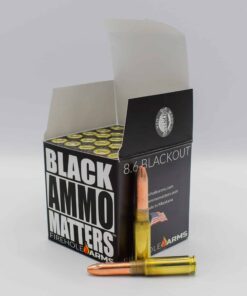
8.6 Blackout (ALL)
How to choose 8.6 Blackout ammo
8.6 Blackout ammo splits cleanly into two jobs, and almost every buying mistake comes from picking a load built for the other one. Get this part right and the rest is detail.
| If you want | Buy | Typical figures |
|---|---|---|
| Maximum quiet, suppressed | subsonic 285gr to 342gr | 1,000 to 1,080 fps, 700 to 840 ft lbs |
| Reach and flatter trajectory | supersonic 160gr to 210gr | 1,900 to 2,400 fps, roughly 2,000 ft lbs |
| Practice and load development | match or FMJ subsonic | cheapest per round, no expansion |
| Hunting inside 150 yards | expanding or fracturing subsonic | designed to open at 1,050 fps |
Grain weight, and what it actually changes
Every subsonic 8.6 Blackout load arrives at roughly the same speed, because the sound barrier caps it at about 1,125 fps at sea level. That means grain weight, not velocity, is what separates one subsonic round from another.
A 285gr load is the lightest common subsonic and the easiest to stabilise in any rifle. 300gr is the middle ground and where most hunting loads sit. 325gr and 342gr are the heaviest common factory weights, carrying the most momentum and the largest frontal area, and they are what people buy the cartridge for in the first place. Across that range you gain roughly 140 ft lbs going from 285gr to 342gr.
Supersonic weights work the opposite way. A 160gr load is the fastest and flattest, 210gr the heaviest and most deliberate, and the muzzle energy stays near 2,000 ft lbs across the range because the cartridge trades speed for mass.
Bullet construction matters more than the number
This is the part that decides whether a subsonic round works on game. At 1,000 fps there is very little velocity available to drive a bullet to expand. Ordinary cup and core projectiles frequently pass straight through without upsetting at all, wasting most of their energy on the ground behind the animal.
8.6 Blackout answers that with its 1:3 twist rate, which spins a 342gr bullet past 250,000 rpm. Fracturing and expanding designs built for that spin come apart or open reliably at subsonic speeds. So when you are choosing between two 300gr subsonic loads, the question is not the weight, it is whether the projectile was designed to work at 1,050 fps. Match and FMJ subsonics are excellent for practice and terrible for hunting.
Barrel length and what it costs you
8.6 Blackout finishes burning its powder in roughly 8 inches of barrel, which is unusual and genuinely useful. It means a short suppressed rifle gives up far less than most shooters expect.
| Barrel | Subsonic 342gr | Supersonic 210gr |
|---|---|---|
| 8 inches | 1,000 to 1,030 fps | 1,900 to 2,000 fps |
| 10 inches | 1,010 to 1,040 fps | 1,960 to 2,050 fps |
| 12 inches | 1,020 to 1,050 fps | 2,000 to 2,100 fps |
| 16 inches | 1,030 to 1,060 fps | 2,050 to 2,150 fps |
Read the subsonic column carefully. Across eight inches of extra barrel you gain about 30 fps, which is nothing. Subsonic ammunition is deliberately loaded to stay under the sound barrier in any barrel, so buying length for subsonic performance buys you weight and nothing else. Supersonic loads gain more, roughly 150 fps from 8 to 16 inches, and even that flattens out quickly.
The practical consequence: a 12 inch 8.6 Blackout with a suppressor is about the same overall length as a bare 16 inch rifle and loses almost nothing. That is the whole design brief of the cartridge, and it is why so many owners run short barrels.
Check your twist rate before you buy ammo
Every rifle properly chambered for 8.6 Blackout should have a 1:3 twist barrel. If yours does not, the heaviest subsonic loads may not stabilise, and the expanding designs will not perform the way they were engineered to. A slower twist barrel will still fire 8.6 Blackout ammo and will still be quiet, and it will quietly remove the main reason to own the cartridge.
If you are unsure, check with your barrel maker before buying heavy subsonics in quantity. Our twist rate guide explains why the number matters more in this cartridge than in any other.
Zeroing subsonic and supersonic together
If you plan to run both from one rifle, and most owners do, understand that they will not share a zero. The difference in point of impact can be several inches even at 50 yards, and it grows quickly with distance.
Record both zeroes, mark your magazines clearly, and confirm on paper before hunting with either. Subsonic trajectory in particular turns into a rainbow past 150 yards, dropping roughly 33 inches at 200 yards from a 100 yard zero. Model your exact load and barrel in our ballistics calculator rather than guessing at holdover.
What 8.6 Blackout is good for
Suppressed hunting inside 150 yards. This is the cartridge at its best. A 300gr class expanding subsonic carries enough momentum and frontal area for hogs and deer at woods distances, with a report closer to a staple gun than a rifle.
Mixed use rifles. Zero with supersonic hunting loads, keep a magazine of subsonics for the same rifle. Being able to swap between a 2,000 ft lb hunting load and a movie quiet subsonic without touching the rifle is the practical magic of the platform.
Property and depredation work. Quiet matters when shooting near livestock, neighbours or at night, and 8.6 Blackout delivers real terminal performance while doing it.
Not for long range. Past 300 yards the supersonics are slowing fast and the subsonics arrived long ago by parabola. If your shooting lives at distance, a 6.5 Creedmoor or 338 Federal serves you better, and buying 8.6 Blackout for it is how the cartridge earns unfair bad reviews.
Shipping and compliance
We ship 8.6 Blackout ammo within the USA to lawful destinations only, and orders over $300 ship free. It remains the buyer's responsibility to know and follow the law where they live, since ammunition rules vary by state and by city. Full details are on our shipping and delivery page, and our returns policy explains the 30 day window for damaged or incorrect orders.
Frequently asked questions about 8.6 Blackout ammo
What is the best 8.6 Blackout ammo for hunting?
An expanding or fracturing subsonic in the 300gr to 342gr range for suppressed woods hunting inside 150 yards, or a 210gr supersonic if you need reach to 300 yards. The key is choosing a projectile designed to open at subsonic velocity rather than a match or FMJ load.
How much does 8.6 Blackout ammo cost?
More than common calibers, because it is a young specialist cartridge produced in smaller volumes with premium projectiles. Expect subsonic hunting loads to sit well above 300 Blackout pricing. Buying by the bucket rather than the box brings the per round cost down noticeably.
Is 8.6 Blackout ammo hard to find?
It was in the first couple of years and it is far better now, with several makers loading it. That said, specific weights go in and out of stock, which is why every listing here shows real availability rather than a permanent backorder button.
Can I shoot 8.6 Blackout in a 338 ARC rifle?
No. They are different cartridges with different cases, chambers and pressures, and they are not interchangeable in any way. Our 8.6 Blackout vs 338 ARC comparison covers the differences.
What barrel length is best for 8.6 Blackout?
Between 8 and 12 inches captures nearly all the performance, with 12 inches the practical sweet spot for a suppressed rifle. A 16 inch barrel gains only about 30 fps subsonic and roughly 150 fps supersonic over an 8 inch.
How far will subsonic 8.6 Blackout shoot?
Treat 150 yards as the practical hunting ceiling. It is trajectory rather than energy that limits it: a subsonic load drops roughly 33 inches at 200 yards with a 100 yard zero, so range estimation errors become misses quickly.
What is the difference between 8.6 Blackout and 300 Blackout?
8.6 Blackout uses a .338 bullet on a shortened 6.5 Creedmoor case and needs an AR-10 sized platform, carrying 700 to 840 ft lbs subsonic. 300 Blackout uses a .308 bullet in a standard AR-15 and carries roughly 500 ft lbs subsonic. The full breakdown is in our 8.6 vs 300 Blackout comparison, and you can shop the smaller cartridge on our 300 Blackout ammo shelf.