300 Blackout Ballistics Chart
Updated July 2026. Figures compiled from published factory load data and industry sources, rounded to typical values. Velocities always vary by rifle, barrel, temperature and lot. Treat every number here as a reference point, then verify with your own chronograph.
300 Blackout ballistics confuse more shooters than any other AR cartridge, because the same rifle produces two completely different sets of numbers depending on which magazine you load. Feed it supersonic ammunition and it behaves like a compact 30 caliber carbine. Feed it subsonic and it becomes one of the quietest centerfire rifles you can legally own. The 300 AAC Blackout cartridge was engineered to do both from a standard AR-15 with nothing changed but the barrel, and to burn its full powder charge in about 9 inches. This page collects the complete 300 Blackout ballistics picture in one place: velocity, energy, barrel length effects and trajectory, for both subsonic and supersonic loads.
300 Blackout ballistics at a glance
- Bullet diameter: .308 inch
- Case: 5.56 case head, shortened and necked up (7.62x35mm)
- Typical subsonic loads: 190gr to 220gr at roughly 1,000 to 1,060 fps
- Typical supersonic loads: 110gr to 150gr at roughly 1,900 to 2,400 fps
- Designed barrel lengths: 7 to 16 inches, full powder burn around 9 inches
- Action compatibility: any AR-15, standard bolt and standard magazines
- Best use cases: suppressed carbines, home defense, hogs and deer inside 250 yards
300 Blackout ballistics chart: subsonic loads
Subsonic loads stay under the speed of sound (roughly 1,125 fps at sea level), so a suppressed rifle produces no ballistic crack, only action noise. This is the configuration 300 Blackout was designed around: a heavy 30 caliber bullet at pistol speeds, from a rifle that still cycles and still feeds from a standard magazine.
| Bullet weight | Muzzle velocity | Muzzle energy | Character |
|---|---|---|---|
| 190gr | 1,050 fps | 465 ft lbs | Expanding subsonic hunting designs |
| 200gr | 1,010 fps | 453 ft lbs | Common practice and plinking weight |
| 208gr | 1,020 fps | 481 ft lbs | Heavy match style bullets, very stable |
| 220gr | 1,010 fps | 499 ft lbs | Heaviest common factory weight, quietest character |
Energy computed from listed weight and velocity. Individual factory loads vary; check the box data for the exact load you shoot.
For context, a 45 ACP defensive load carries around 400 ft lbs from a pistol. A 220gr subsonic 300 Blackout carries roughly 500 ft lbs from a rifle you can shoot with both eyes open and no hearing protection when suppressed. If you want more payload at the same speeds, that is exactly the niche the bigger 8.6 Blackout ballistics chart covers, with 285gr to 342gr bullets at the same 1,050 fps.
300 Blackout ballistics chart: supersonic loads
Supersonic loads give up the movie quiet signature and buy velocity, flatter trajectory and roughly triple the energy. This is where 300 Blackout ballistics look like a classic intermediate rifle cartridge, broadly comparable to 7.62×39 with better bullets and better feeding.
| Bullet weight | Muzzle velocity | Muzzle energy | Character |
|---|---|---|---|
| 110gr | 2,375 fps | 1,378 ft lbs | Fastest common load, varmint and defensive designs |
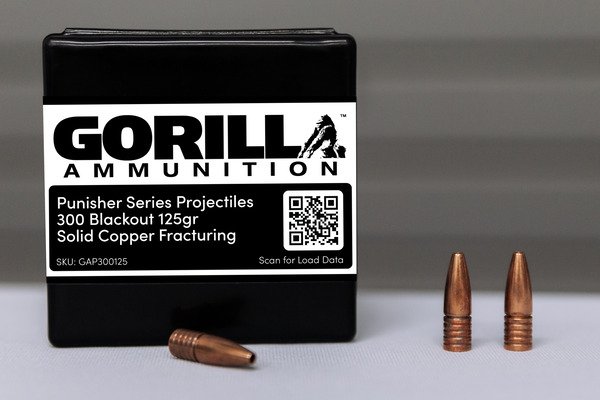
| 125gr | 2,215 fps | 1,362 ft lbs | The all purpose weight, most factory choices |
| 135gr | 2,085 fps | 1,304 ft lbs | Balanced weight and speed |
| 150gr | 1,900 fps | 1,202 ft lbs | Heaviest common supersonic, deep penetrating hunting loads |
Note the energy band: roughly 1,200 to 1,400 ft lbs across the weight range. The cartridge trades speed for mass and keeps its payload close to constant.
One barrel change: why the AR-15 is the whole story
The signature engineering choice in 300 Blackout is not exotic. It is restraint. The cartridge uses the 5.56 case head, so a standard AR-15 bolt grips it without modification, and it fits standard magazines at standard capacity. Converting a rifle is one barrel, nothing else.
That single decision explains the numbers above. The case was sized so that a full powder charge burns in about 9 inches, because the designers assumed short suppressed barrels from the start. And the twist rate, commonly 1:7 or 1:8, was chosen to stabilize everything from a 110gr varmint bullet to a 220gr subsonic, which is why one rifle shoots the entire table on this page. None of the individual numbers in 300 Blackout ballistics are extreme. The combination in one AR-15 magazine is the achievement.
Frequently asked questions
How fast is 300 Blackout?
Subsonic factory loads run roughly 1,000 to 1,060 fps with 190gr to 220gr bullets. Supersonic loads run roughly 1,900 to 2,400 fps depending on bullet weight and barrel length. The 300 Blackout ballistics tables above break both down in detail.
How much does 300 Blackout drop at 200 yards?
With a 100 yard zero, a typical 125gr supersonic load drops 7 to 9 inches at 200 yards. A 220gr subsonic load drops 33 to 40 inches at the same distance, which is why subsonic shooting stays inside 150 yards in practice.
What barrel length is best for 300 Blackout?
The cartridge reaches nearly full performance around 9 inches of barrel. A 9 to 10.5 inch barrel is the sweet spot: almost all the velocity of a 16 inch gun in a package built for a suppressor.
Is 300 Blackout good for deer and hogs?
Yes, inside its envelope. Supersonic hunting loads are a clear yes to 250 yards. Subsonic loads work at woods ranges with expanding bullets designed for slow speed, kept inside roughly 100 to 150 yards by trajectory and energy.